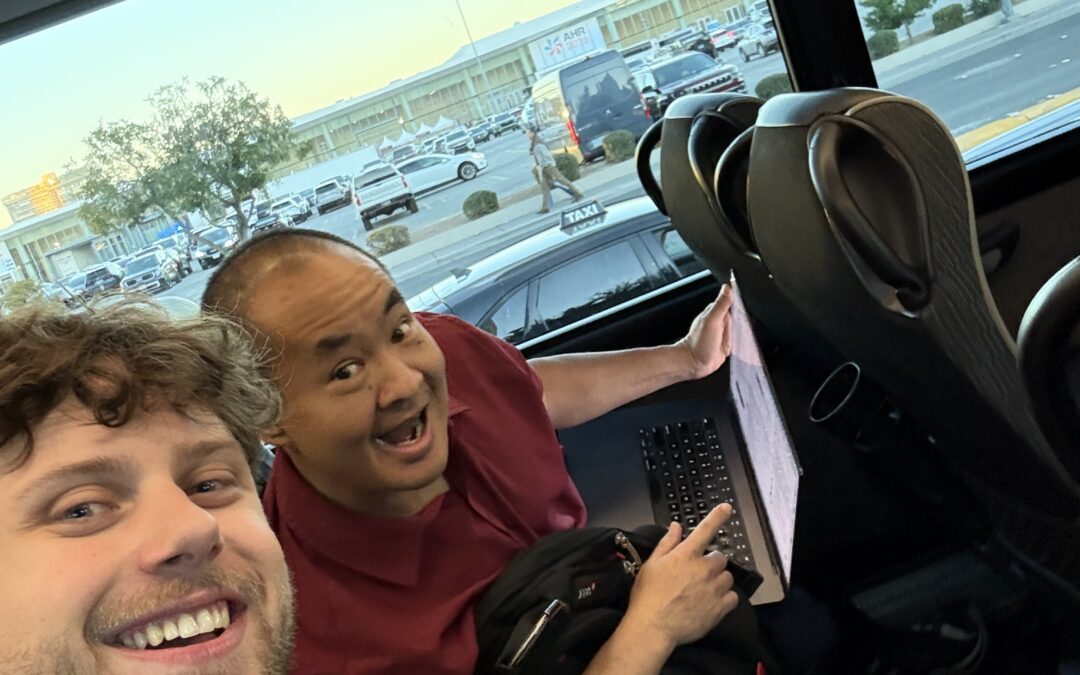
A 27-year-old walks onto the floor of AHR Expo 2026 in Las Vegas — 50,000 HVAC professionals, hundreds of equipment booths, and not a single person expecting him. No booth. No badge sponsor. Just an iPhone, a mentor, and a decision to go all-in on one industry. Dennis Yu and I break down the full story in this 25-minute conversation above — then read below for the lessons that every HVAC contractor and young entrepreneur needs to hear.
Choosing HVAC Wasn't Random — It Was Strategic
I didn’t start in HVAC. I started where most young entrepreneurs start now — building my own things on social media. I was running my own brands, spending my own money, learning what actually moves the needle versus what just looks good on a dashboard. Every dollar was mine, every mistake was mine, and that’s the fastest education in marketing you’ll ever get. Then I met Dennis Yu at DigiMarCon, and that introduction changed the trajectory entirely. Dennis opened the door to the world of local service businesses — painters, window and door companies, pressure washers, plumbers, HVAC contractors. Suddenly I wasn’t just marketing for myself anymore. I was applying everything I’d learned to businesses where the stakes were real and the results had to show up in the form of a ringing phone. Each vertical taught me something new, but with every new client, I kept feeling the pull to go deeper instead of wider. That pull led me to niche down, and then niche down again, until I landed on the industry where the math made the most sense and the people were worth building a career around.
The shift happened when I realized one critical number: the average HVAC replacement job is worth $12,000 to $35,000. That's not a $200 dinner reservation or a $50 gym membership. When a homeowner's 15 SEER system dies in August in Houston, they're writing a five-figure check to someone. The contractor who gets that call — not the one who ranks for vanity keywords, but the one whose phone actually rings — wins a life-changing amount of revenue per job.
That math changed everything. As Dennis Yu explains in our conversation, when you choose a niche that sells high-ticket services, every marketing dollar works harder. One more booked replacement estimate per week at a $22,000 average ticket? That's over $1.1 million in additional annual revenue for the contractor. The MAA framework — Metrics, Analysis, Action — demands that we measure what matters. And what matters to an HVAC contractor isn't impressions or website traffic. It's booked calls, closed estimates, and revenue per lead source.
What Walking the AHR Show Floor Actually Taught Me
Booking a flight to Las Vegas for AHR 2026 wasn't a "business trip" in the traditional sense. I didn't have a booth. I didn't have a speaking slot. I just showed up with my iPhone and started introducing myself to the people who build, sell, and install the equipment that keeps America comfortable.
Here's what most marketing people don't understand about HVAC: these contractors built their businesses on trust and craftsmanship. They know the difference between a 14 SEER and an 18 SEER system, they understand shoulder season cash flow problems, and they can tell within 30 seconds if the person they're talking to actually understands their world or is just another agency on a sales call.
Walking that show floor changed me. I talked to equipment manufacturers. I met software providers building tools for ServiceTitan and Housecall Pro integrations. The biggest lesson? These people are generous, genuine, and hungry for real help. They're not looking for another marketing vendor who sends a PDF ranking report every month. They want someone who understands that a number-one ranking for "HVAC services" in a zip code where nobody searches that phrase is worth exactly zero dollars. The team at Local Service Spotlight has seen this pattern across every home service vertical — contractors with great reputations and terrible digital visibility, invisible to the homeowners searching for them right now.
The Power of Niching Down — By the Numbers
Dennis makes a point in our interview that I want every contractor and agency owner to hear: when you've done the same thing for 30 HVAC companies, 95% of the process is repeatable. The onboarding gets smoother. The troubleshooting gets faster. The reporting gets tighter. You're not reinventing the wheel every time a new client signs — you're applying a proven system to a new market.
Here's the Metrics side of the MAA framework in action. The HVAC industry has roughly 100,000 to 200,000 technicians and contractors in the United States. AHR alone draws 50,000+ attendees. That's a focused, reachable audience — not the entire internet. With a disciplined Dollar-a-Day strategy, we can put high-authority, in-person content in front of the exact people who need to see it, for a few hundred dollars a month.
The Analysis? A 100% improvement on 2 clicks is meaningless. But when you show up in person at AHR, record interviews with industry leaders, post those videos on Facebook (where the contractors actually spend time — not Instagram), and then turn those conversations into articles that demonstrate real expertise, the compound effect is massive. Every piece of content reinforces every other piece. The contractors who see your videos at AHR start following you on social. They share your content with their contractor buddies. Those referrals turn into phone calls, and those calls turn into clients.
The Action for any agency owner reading this: pick one vertical. Not three. Not "home services broadly." One. Then go to their industry conference. Show up with nothing but your phone and a genuine desire to understand what these people deal with every day. Interview everyone who will talk to you. The vendors who paid $15,000 to $20,000 for their booth? They're expecting to talk to people. You walking up and offering to feature them in a video is a gift, not an imposition.
Collaboration Beats Competition Every Time
One of the most counterintuitive things Dennis taught me is that your "competitors" are your best growth channel. We met Daniel of Net Marketing at AHR — technically a competitor, since he does HVAC marketing too. But instead of avoiding each other, we spent time making promotional videos together, cross-promoting, and sharing connections. He's promoting us. We're promoting him. Why? Because the HVAC marketing space is massive, and abundance beats scarcity every single time.
This collaboration mindset extends across verticals too. Dennis shared how Ethan Van De Hey grew Infinity Exteriors by an extra $20 million last year through roofing marketing. George Paladichuk built a SAAS company with 115+ roofing companies. The cross-referral opportunities between these niches are enormous — roofing companies refer HVAC companies, landscaping connects to pest control, and the relationship web keeps growing. The apprentices trained through High Rise Influence are learning this ecosystem approach from day one — running geo-grid reports, managing Dollar-a-Day campaigns, and building the Content Factory pipeline that powers all of it.
Donnivin Brown from Southern Comfort Heating and Cooling in Houston came to us through this exact pattern. It wasn't even an HVAC connection that drove the introduction — it was mutual relationships in roofing and landscaping. Then Donovan brought two more HVAC contractors, plus referred another contractor named Joeseph Davis of Brother's Air in Texas. That's the compound interest Warren Buffett talks about, applied to business relationships instead of bank accounts. Building brand mentions across the ecosystem creates a trust signal that no amount of paid advertising can replicate.
Why Content From the Field Outperforms Everything Else
Dennis dropped a line in our conversation that stuck with me: "We can make Luke a celebrity in the HVAC industry with a few hundred dollars." That sounds bold. But the math backs it up when you understand E-E-A-T — Experience, Expertise, Authoritativeness, and Trustworthiness — the framework Google uses to evaluate content quality.
A selfie video shot on an iPhone at the AHR convention center — with real HVAC equipment in the background, real contractors in the conversation, and real industry knowledge on display — carries more authority than a $10,000 studio-produced brand video ever could. Google and AI models like ChatGPT are increasingly recognizing entity relationships between people, companies, and industries. When my face shows up next to Sensorcon's Dave Massner talking about carbon monoxide safety in HVAC systems, or next to Dennis Yu discussing Knowledge Panels, those connections build a web of topical authority that algorithms reward.
The map pack visibility strategies we run for HVAC clients work better when the contractor's brand already has this kind of digital footprint. The team at Local Service Spotlight helps contractors turn their 5-star reputation into a structured digital asset that Google and ChatGPT actually recognize.
Three Things Every HVAC Contractor Should Do This Week
If you're an HVAC contractor reading this between service calls, here's the Action portion of the MAA framework — three things you can execute today, not "someday."
First, shoot a 60-second video on your next install. Pull out your phone, show the homeowner's city (not their face or address), describe the system — "Just finished a 3-ton, 18 SEER Carrier install in Katy, Texas" — and post it to your Google Business Profile and Facebook page. Tag the city. This is the kind of in-person, proof-based content that builds digital assets over time, and it takes less time than filling out the permit paperwork.
Second, check your Google Business Profile categories. Open your GBP dashboard, click Info, and confirm your primary category is "HVAC contractor" — not "heating contractor" or "air conditioning repair service." Then add your top 5 service areas by zip code. This single fix has moved the needle more than any other optimization we've implemented for clients, and we've documented the results in our Houston audit breakdown.
Third, ask yourself: if someone Googled my name right now, what would they find? Building a personal brand website through Local Service Spotlight is how contractors go from "good reviews on Google" to "the authority in your market." Dennis Yu has built his entire career on this principle, and the same playbook works for HVAC company owners who want to be the trusted name in their city — not just another listing in the map pack.
The Bigger Picture: Building Something That Compounds
Here's what I know after AHR 2026: this industry is full of hardworking, patriotic men and women who built their businesses the right way — through craftsmanship, handshakes, and showing up when the AC dies at 2 AM. They're great at what they do. Most of them are not great at marketing, and they know it. They don't understand local SEO strategy. They don't understand behavioral targeting. They don't understand why their competitor with fewer reviews and worse service is ranking above them in the map pack.
HVAC Growth exists to fix that gap. Not with gimmicks. Not with vanity metrics. Not with 12-month contracts and PDF reports. The systems we use to scale local marketing are built on the same MAA discipline that Dennis Yu has taught across thousands of local businesses. Metrics that tie directly to the phone ringing. Analysis that separates signal from noise. Action that a contractor can execute between service calls.
If your son or daughter wants to learn how to actually make the phone ring for local businesses, the AI Apprentice Program at High Rise Influence is where Dennis Yu and Jack Wendt are training the next generation. It's not a get-rich-quick scheme — it's a year-long mentorship built on reputation, real results, and the same targeted keyword activity strategies that drive results for our HVAC clients every day.
And if you're an HVAC contractor who's tired of paying $3,000+ a month for marketing that doesn't make the phone ring — stop guessing. Start measuring. Request your free HVAC marketing audit here and let us show you exactly what your geo-grid looks like, where you're losing calls, and what to do about it.