Dennis Yu, of Local Service Spotlight, breaks it down in this 27-minute video
Donnivin Brown paid $3,500 per month for nearly six months. During that time, his rankings collapsed and his website traffic dropped to almost zero. His phone slowed down. Meanwhile, the agency sent reports celebrating “100 keywords ranking.”
We could stop right there because that disconnect tells you everything you need to know, but, of course, we won’t.
That aforementioned breakdown comes from a live Marketing Mechanic audit where Dennis Yu reviewed Donnivin’s company, Call Southern Comfort, a Houston HVAC contractor with a 4.9-star rating and 276 Google reviews. On the surface, the business looks strong digitally. Underneath, their foundation is weak.
The Website Wasn’t Driving the Business
Dennis opened this audit with a blunt observation, “Their Google Business Profile was actually driving it. Their website drove almost nothing.”
Most contractors believe their website drives their Google Maps ranking. That is not how it works. Your website and your Google Business Profile are separate systems. They influence each other, but Maps rankings depend primarily on proximity and real engagement, not how many pages you create.
If the phone rings, it is usually because your Google Business Profile is performing. If the phone stops ringing, that is where we look first.
The Real Problem: Dozens of Duplicate City Pages
The agency created multiple geo pages targeting Richmond, Rosenberg, Sugar Land, and nearby Houston suburbs. At first glance, the URLs looked different, but the content was nearly identical. Each page followed the same formula: “AC Repair in [City Name]” with boilerplate text and generic imagery. There were no strong backlinks from other Houston businesses. No local partnerships reinforcing authority. No meaningful engagement data.
This is egregious online marketing malpractice, but still to this day many agencies think this location service page spam works. Not because they all are trying to get one over on you, although some of those nefarious characters do exist (be careful!), but because many simply just do not know any better.
Dennis ran the pages through AI evaluation tools. The result flagged scaled content abuse. As he explained, “Google’s standards have always been the same. They just selectively decide when to enforce them.”
When enforcement happened, the rankings dropped fast.
Why the Reports Looked Impressive
The agency claimed success because the dashboard showed growth in keyword rankings. But context matters. Ranking #1 for a term nobody searches does not generate revenue.
Dennis reviewed the data using Ahrefs and SEMrush. He found rankings tied to obscure variations and branded searches. Meanwhile, competitive phrases like “AC repair Houston” were not dominating in high-density neighborhoods.
Simply put, that agency had them winning on every keyword that did not actually matter to their business success and using that to claim that their strategies were working.
Meanwhile, Dennis checked into the competitive phrases and said plainly in response to seeing a key phrase at 89th, “No one goes to result 89. We need to see the phone ring.”
I agree, Dennis, that is the only metric that matters to me too.
How Google Maps Actually Works
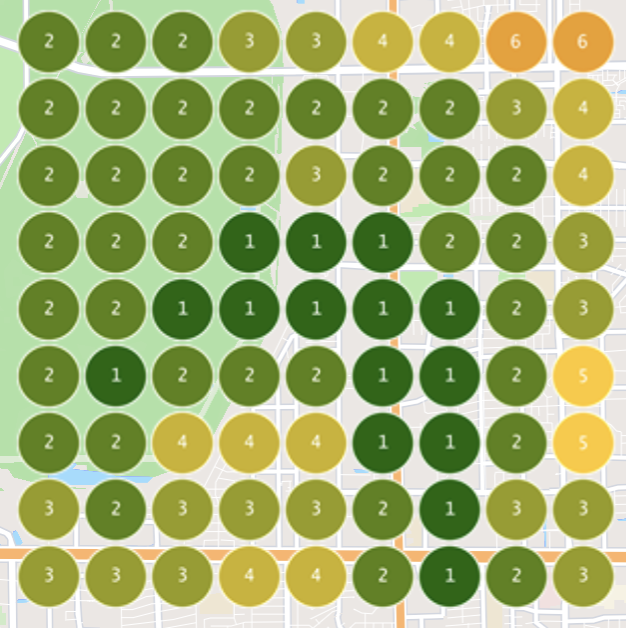
Example of what a good keyword ranking looks like
Dennis drew the explanation on a piece of paper in the video I shared. From your physical office, Google evaluates a radius, the closer the searcher is to you, the stronger your proximity advantage.
But proximity alone is not enough. You must rank in the top three inside neighborhoods where people are actively searching. Ranking first in a low-population area outside the city center will not move revenue.
To measure this, we use Local Falcon to run geo-grid reports. The grid shows exactly where you rank block by block. Green dots on important keywords, in high-density zones correlate with calls. Yellow and red do not.
The Three Signals That Matter
Inside Google Business Profile insights, three engagement signals dominate: website clicks, driving directions, and calls. Driving directions are particularly powerful because Google can verify real-world movement. If someone clicks directions and navigates to your location, that is a strong trust signal.
Bot traffic cannot replicate that reliably. Some agencies use CTR manipulation tools that simulate searches and clicks from fake IP addresses. Those tactics eventually get detected. Dennis referenced the well-known case of someone pulling 100 phones in a red wagon through London to manipulate traffic signals. Google corrected it quickly. Shortcuts do not last. What works is real homeowners inside your service area engaging with your listing.
That is why we only work with only the best, the ones, like Donnivin Brown, who do such great work that they don’t feel the need or urge to cheat the system. Your marketing team should reflect your values in that same way. It wasn’t dumb luck and shortcuts, that found you success, it was doing the work and doing it right. Find an agency that reflects those same values you hold and your efforts will be rewarded with compounded success.
Why the Beautiful Website Didn’t Help
Call Southern Comfort has strong branding, clean design, and clear messaging. The website looks professional. But analytics showed almost no organic traffic. No traffic means no authority signals. No dwell time. No click paths to the Google Business Profile. Spending more money redesigning a site without traffic is like renovating a showroom no one enters.
Dennis said, “You could spend thousands of dollars on a new website. Doesn’t matter because there’s no one there.”
Building authority is critical. To give you a sense of how many moving pieces go into effectively marketing your company online, beyond today’s examples. There are many others, like earning a Google Knowledge Panel. The team, led by Dylan Haugen and Dennis Yu, at Local Service Spotlight helps you get that set up, while we focus on strengthening your personal brand so your business amplifies your reputation and your reputation amplifies your business.
What Would Have Worked Instead
The solution is publishing genuinely helpful content such as HVAC repair pricing, installation timelines, and troubleshooting guides. You need to focus on amplifying that content to homeowners within specific neighborhoods. Then focus on measuring Google Business Profile insights weekly and tying rankings directly to CRM call data.
If homeowners in Sugar Land consistently click your listing, request directions, leave reviews, and consume your content, Google increases your visibility in Sugar Land. That is how Maps rankings move.
The Agency’s Own SEO Raised Questions
Dennis also audited the SEO agency’s website using Ahrefs and SEMrush. The results showed minimal organic traffic and very limited keyword rankings. For a company selling SEO, that matters.
If your SEO company cannot rank its own site, you should pause. Authority is visible. Tools reveal it in minutes.
As Dennis pointed out, running a proper audit takes only a few minutes with the right tools. There is no excuse for vague reporting. Then, once you are finished, you have your, as we like to call it, MAA, which stands for metrics, analysis, and action. You are then able to understand the what, the why, and the what the heck to do with it. That is how you win.
The Core Lesson for Contractors
If you do not know how many calls come from your Google Business Profile versus PPC versus organic website traffic, you cannot manage performance. If you are not reviewing geo-grid results and CRM call data together, you are guessing.
Dennis summed it up cleanly, “Own your data. Run your audits. Hold your team accountable.”
Google Maps rankings are not driven by AI page multiplication. They are driven by proximity, engagement, reviews, and real-world signals. When those signals improve in the right neighborhoods, calls increase. If rankings go up but calls do not, the rankings are meaningless.
If you are an HVAC contractor, start by reviewing your last 90 days of Google Business Profile insights alongside your CRM call data. Then run a geo-grid report for your top service areas. Or, if you’d rather focus on HVAC and serving your clients, you could have me do it for you.